Watkins Glen

A beautiful morning when we wake at the Seneca Lodge.  Blue sky, birds are singing and it isn’t going to be too hot.  Such a change after some of the hot gritty places we have stayed in.  This is the big day for the cardboard boat races at the lakeside park and everyone is in town.  We find a place for breakfast and then drop off Lorraine and Laurel to do some shopping while Dave and I go to the International Motor Racing Research Centre which is run by enthusiasts dedicated to keeping the history of motorsport at the Glen alive.  With the Glen’s rich history not only in Formula 1 but also Nascar and Indycars they have a pretty impressive pedigree of Directors including people like Roger Penske.  First off we are interviewed by Ron Hills for a YouTube piece to be shown on youtube/theracereport.TV in a few weeks.

After a quick browse through their expansive collection we are off to the circuit to drive a few laps around the circuit behind a control car.  I was last here in 1971 to watch the US Grand Prix but there was no chance to experience the circuit from the track side of the fence that time.  Our time slot is delayed 30 minutes because there are dozens of Corvettes in town and they seem to get priority – no problem, we get to admire them streaming past making nice noises.  The it’s our turn and I find myself behind a Holden masquerading as a Chev SS – hmm 415 horsepower vs. 90 hp nearly 50 years ago might be fun…  As it turned out he could have used some driving lessons and Navy Car could easily keep especially through the corners.   Dave was right behind me in RIP and also having a fun time.  Unfortunately there was a no-passing rule so not as much fun as I’d hoped but it did mean we got to enjoy the views of this beautiful circuit with its freshly laid tarmac as well.

BHOZ1442[1]

Louisville to Watkins Glen

The last day of the National Meeting where we’ve met some amazing people gathered from all over the US and Canada who share a common interest in MGs.  This morning everyone is driving to the waterfront where all 800 plus cars will be on show to the public.  A beautiful location on the banks of the Ohio River and close to the downtown area.

JTAK6676[1]

We have a long drive ahead and leave around 2 in the afternoon to mix it with the trucks on the interstate heading north and then west to Watkins Glen passing through Ohio, Pennsylvania and into New York State.  I reflect on a couple of conversations, the first one overheard when one of the MG people is leaving one of the sessions and talking loudly on the phone to his wife.  “Hi darling,  did you have a good day?  Did you go to the shooting gallery?”  This was just after we had read about the Tennessee politician who was running a fund-raiser and offered an AK-47 assault rifle as a door prize.  When someone queried whether this was an appropriate offer in the aftermath of the Orlando shootings he responded by upping the door prize to two AK-47s.  “No-one is going to take away my right to bear arms”.  The other conversation was with a lady sitting in her Cadillac looking at our cars outside the motel.  “They’re cute cars, where are y’all from?”  “We’re from Australia” I reply.  “Oh, that’s awesome, how fantastic (slight pause) is that far away from here?”

Some amazing sights on the interstate highways – pick-up trucks with oversize wheels, motorhomes towing full size Jeeps as their run-around and convoys of interstate transports dwarfing our tiny little cars.  But we survived another day..

FIHM8901[1]

Louisville – Muhammed Ali and Locust Grove

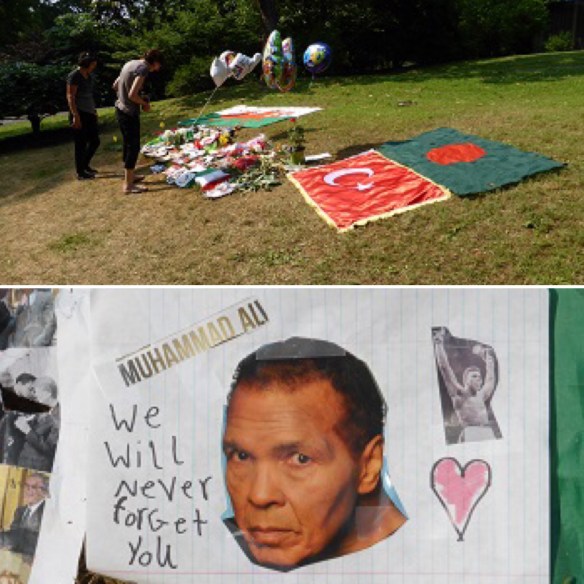
We have a free morning so time to visit another couple of Louisville’s attractions.  First stop is the cemetery where the body of Muhammed Ali was laid to rest just a few days ago.  At the gate we were told that around 50,000 people had visited already and we were lucky to be there early in the morning before the rush.  When we got to the grave site we were surprised to see how simple it was.  Just a few newly laid pieces of turf partly covered by various flags, photographs with written inscriptions and a few wilting flowers.  We were sure that in a few weeks there will be an impressive headstone and all the tourist minibuses will be lining up but for now it was a peaceful and simple memorial to a very great man.

KVJZ5025

The cemetery was also a resting place for thousands of soldiers who died in the Civil War.  Where we were standing many headstones were unidentified or with numbers only – unknown soldiers who died for a cause which in some parts of the US seems to be still not finally settled.

HDCO1392

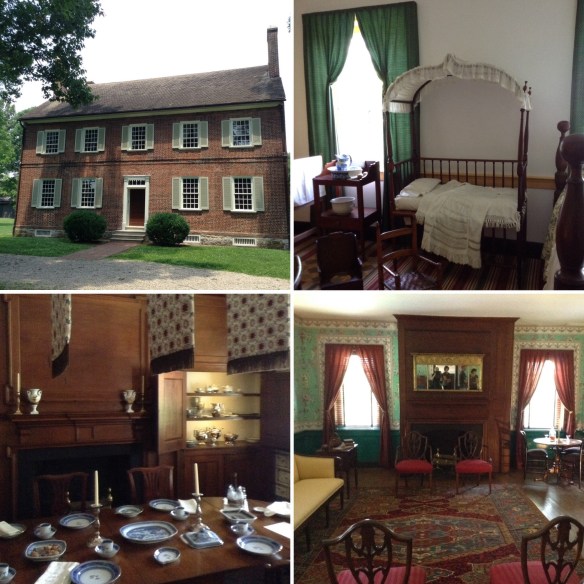
Next stop was the historic Georgian house called Locust Grove.  Founded in 1790 by William Croghan and Lucy Clark it played a very significant part in the history of this area of the US.  Lucy Clark’s younger brother was William Clark who together with Merriwether Lewis were the first Europeans to find a way through the Rockies and got to the West Coast – a little like Burke and Wills except they actually discovered some useful land and made it back to Locust Grove to tell the tale.  Her older brother was George Rogers Clark who started life as a surveyor but rose to become a general leading the Kentucky militia in the War of Independence.  His success in beating superior British forces earned him the nickname ‘Conqueror of the North West’ and he hadn’t even reached his 30th birthday.  From then on it was all downhill.  A former colleague spread malicious stories about Clark’s drinking habits and financial management back at headquarters in Virginia which lead to him losing his commission and not being paid for his efforts.  He spent the last half of his life living at Locust Grove with his sister, suffered a number of debilitating strokes and had his leg amputated after falling into a fire.  Meanwhile the former colleague did very well – where’s the justice in that.

The original house has had a charmed life since it was built in the late 1700s.  It just survived the developer’s bulldozer in 1961 and was then completely renovated recently.  We learnt that while the US has a National Trust register of listed buildings similar to Australia, the final decision on whether a building is to be preserved is made by the local municipality with little recourse to a higher authority.  And everyone knows that local municipalities are never influenced by developers…

TPYO4891

Louisville – Churchill Downs

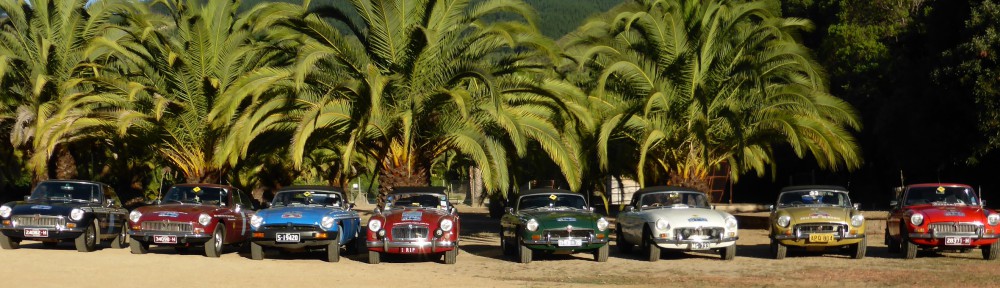
The registration day for MG 2016, the National Meeting for North American MG Clubs.  During the day the hotel car parks filled with around 700 MGs from all over the US and Canada plus a few ring-ins from the antipodes.  We were given a warm welcome and many wanted to find out more about our adventures so it was a good day for meeting and chatting to people from all over.   While we didn’t spot any pre-war models, there were many TCs and TDs, the models which started the British invasion of the US market and as expected a larger number of MGA and MGBs.  Quite a few highly restored ‘trailer queens’ brought in to show off at the Concours but also many cars driven from distant starting points.  Most people seemed pretty excited to be there but we did hear one passenger say she never, ever wanted to do that again.  It was about 36 deg C and 70% humidity so maybe she was just having an off-moment or maybe she was talking about something else altogether….

PCPV6776 VAHQ4124

I took Navy Car to a nearby service centre for a little TLC before the journey resumes.  Ross had found an Express Service where we could drain and refill with fresh oil.  We had to shop around to find the right oil grade which didn’t seem to be a problem to the service guys.  They helped us remove and refit the sump shield, grease the front suspension and prop shaft, check everything underneath and then didn’t want to charge us because we hadn’t used their oil.  A $20 tip seemed to be well received and we went on our way.  The service on our car at home a few weeks ago cost $550 and it didn’t even need greasing!

In the evening we drove a few kms down the road to Churchill Downs, the home of the Kentucky Derby – the US equivalent of the Melbourne Cup.  Interestingly the track surface used for the Derby and most other races is sand over clay which is more durable and consistent than turf and probably essential for a track where they run around 700 races each year.

IAYK0178

Auburn to Indianapolis

Today’s route took us from Auburn heading towards the MG fest in Louisville via Indianapolis the home of the self-proclaimed “Greatest race track in the World”.  There may be a few other contenders who would put their hands up for that title but there’s no doubt it’s impressive in every way.  The first 500 race on the 2.5 mile rectangular oval track was held on Memorial Day 1911 attended by 80,000 spectators and the winning driver averaged 120 km/h.  Until 1935, the track was paved with bricks, hence the nickname “The Brickyard” but as speeds rose this surface became increasingly dangerous and there is now just a 1 yard section of the bricks remaining near the start/finish line to remind future generations of this piece of history.  Until 1961 the race cars maintained a traditional front engine layout but in that year Jack Brabham created history by entering his rear engine car.  He managed a 9th place finish and would have done even better except for a fuel consumption miscalculation requiring an extra pitstop but the die was cast.  British driver Jim Clark driving a rear engine Lotus won easily in 1965 followed by Graham Hill in 1966.  Today the quickest cars can lap at an average speed of 230 mph or 370 km/h so it must be just a very spectacular blur to the 350,000 spectators.

RFZM3717[1]r

What was supposed to be a quiet uneventful drive turned out not so well for Simon driving Navy Car.  A minor misunderstanding with another car as we were leaving the morning tea stop resulted in a scraped rear quarter panel – poor Simon was very disconsolate, his first ever accident and the first scrape for Navy Car apart from a dinged bumper over-rider caused when a van backed into us at a toll booth in Turkey.  The blessing was that no-one was hurt and panels can be easily fixed.

Chicago to Auburn

Our first day on the road although we feel somewhat like imposters discreetly driving a renta-Chev a few cars lengths behind three MGs. RIP, Blue B and Navy Car are driving to Louisville via Auburn where we will visit the Duesenberg Museum while Red and Green Car are taking the long way around via Nashville to satisfy their love of Country Music.
A quick recap of the group’s trip so far after they all met again in Vancouver 3 weeks ago. Most of the group have had a pretty uneventful drive enjoying the Rockies and meeting MG enthusiasts along the way. This trip has generated considerable interest among US and Canadian enthusiasts because they are all gathering at the MG National Meeting in Louisville running from 13-17 June. The others have found that some of the people they meet remember more about our previous adventures than we do just from reading the various blogs. A few glitches along the way – Red Car burnt an exhaust valve and failed an overdrive solenoid. Green Car had an alternator failure and Navy Car burnt out its brand new starter motor. There’s a bit of a pattern here. All the parts which failed apart from the exhaust valve are Chinese or Indian copies of the Lucas parts which were fitted to the original cars. It seems the clever after-market replicators have managed to incorporate all the original faults and added a few new ones so they are now totally rubbish. Oh well, all part of the experience I suppose… A few hours work yesterday in the Chicago hotel car park and everything is working again ready for our trip today.
An easy drive out of Chicago using the express toll lanes and we were soon across the border and driving through the lush green corn fields of Indiana. No dramas at all and after a short lunch stop we arrive in Auburn where we find the museum dedicated to some of the most exclusive cars ever built in the US –Duesenberg, Cord and Auburn. Fred and Augie Duesenberg were German immigrant self-taught engineers who started building engines and race cars firstly in Minneapolis then moving to New Jersey and Indianapolis. Good engineers don’t always make good business people and they experienced several financial disasters before being rescued by E.L. Cord in 1926. He wanted a US built Duesenberg to compete with Mercedes Benz, Rolls Royce, Hispano-Suiza and Isotta Franschini. Cord had built a serious manufacturing empire including companies such as the aero engine builder Lycoming but even with his backing the company ultimately failed in 1937 but not before they had built some very beautiful and technically impressive cars. A few years earlier, Cord had also bought the Auburn manufacturing business from the Elkhart brothers, less expensive than the Duesenberg but still a hard sell in the depression years. Cord also wanted a more technically advanced and innovative car bearing his name and in 1935 the 810 Cord designed by Gordon Buehrig was launched at the NY Motor Show. Words don’t do the Cord justice so the pic on the right of the middle row will give those who haven’t seen them before some feeling for how advanced this car was for 1935. Unfortunately the clamour of orders which followed encouraged Cord to start deliveries before all the teething problems were sorted so it was all a bit of a disaster but that hasn’t stopped the Cord 810 being one of the most collectible cars ever produced in the US.

SMSG2132r

Dinner tonight was courtesy of Bob Evans, yes, the Bob Evans chain of family restaurants which means they don’t serve alcohol. Still we persevered signing a pledge of abstinence so we could enjoy their promotion of everything with bacon. Lorraine was about to tuck into a vegetarian salad until she spotted the liberal addition of bacon and I reluctantly turned down the opportunity to enjoy strawberries with bacon.